


Nobody cares about what you have to say. That’s only if you don’t care about what you have to say either.
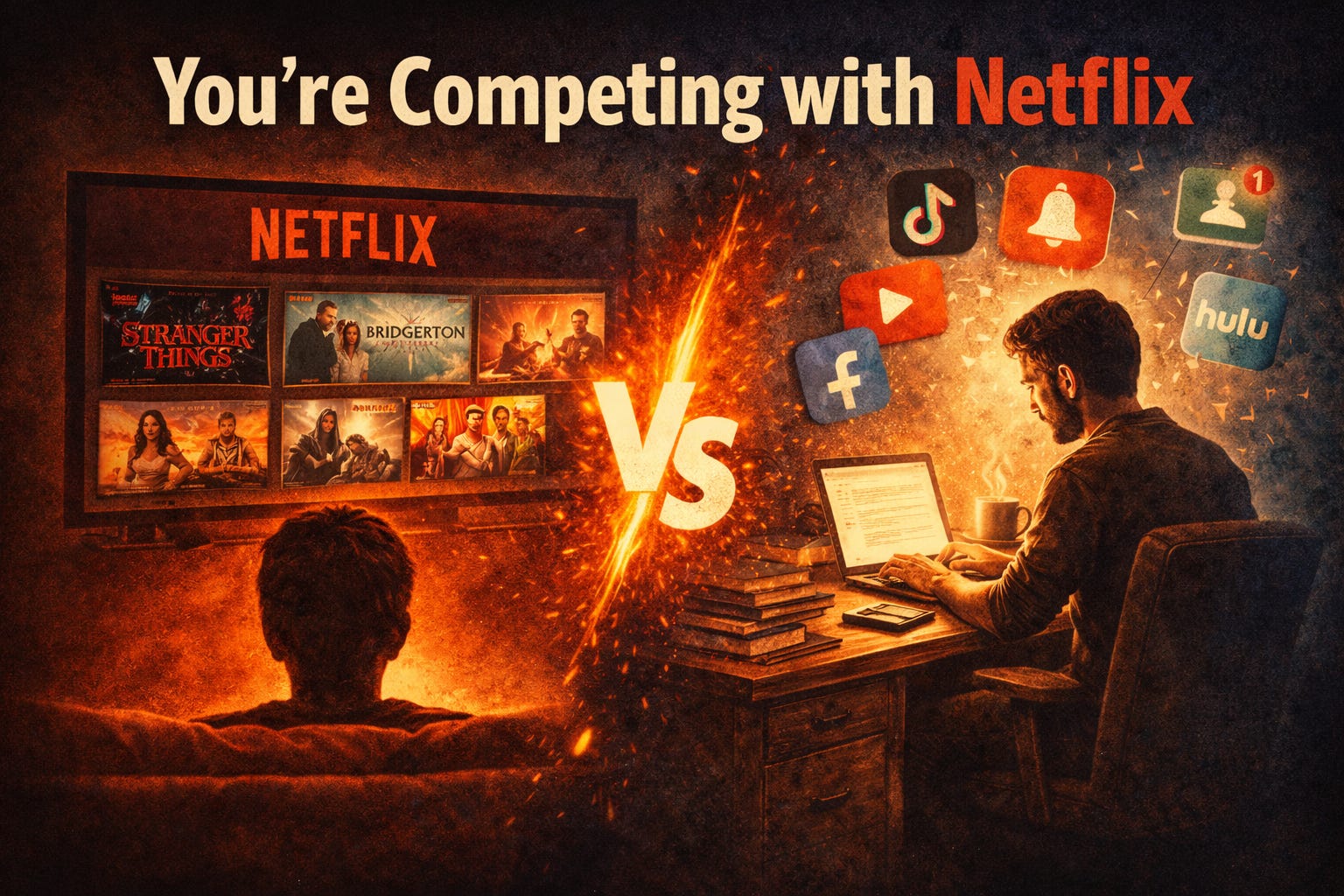
When I write and create, I tell myself I’m competing with Netflix. They have most people’s attention.
I remember when Stranger Things dropped and everyone was talking about it. I’m sure millions of people were binging episode after episode. Then I thought about my content sitting there, waiting for someone to click. How could I possibly get people to choose my writing over that?
It was intimidating at first. Because it’s not just Netflix. It’s Hulu. YouTube. TikTok. Every other creator in your space. The entire attention economy is fighting for the same eyeballs you need.
No wonder content creators obsess over hooks. No wonder everyone’s screaming “STOP SCROLLING” in the first three seconds. We’re not competing with each other anymore. We’re competing with everything.
The Shift That Changed Everything
For a moment, I fell into that trap too. Learning about hooks. Chasing clicks. Treating attention like strategy rather than something you earn.
But then something clicked. I realized my personal brand wasn’t about grabbing attention. It was about sharing things actually worth talking about. Not taking people’s time for granted.
So I changed my approach. I wanted to make better, more substantial content. Nothing meaningless. Everything helpful in some shape or form. Mostly through storytelling.
Because here’s what I learned: story is what makes content not meaningless.
A song without story is just noise. A movie without story is just moving pictures. Story is THE content. Story gives it meaning.
That’s your actual advantage over Netflix. They have budget and algorithms, sure. But you have something they can’t manufacture at scale: genuine stakes, real transformation, specific expertise that comes from living through your experience.
What “Mattering” Actually Means
When I say post content that matters, I don’t simply mean valuable information. The internet is drowning in valuable information. Tips. Hacks. Listicles. AI-generated advice that technically answers questions in seconds, but leaves you feeling empty.
Content that matters does at least one of these things: gives a lesson, solves a problem, offers hard-won advice, shows someone how to do something they’re struggling with.
But here’s the key. It has to be substantial. More substantial than dancing videos, clickbait, rage bait, AI slop. It’s content created with the genuine intent to help someone, not just capture their attention for three seconds before they swipe.
I learned this from Kieran Drew, a creator who launched my online writing journey. He started on Twitter, recently started on LinkedIn, now runs a newsletter and a course where I learned how to write for social media. What made his content cut through everything else?
His writing style and approach. He taught me how to make good hooks from what I’d already written. How to write stories in a format that helped me not overthink, like writing about who I was before something, who I became after, and the bridge between them.
It wasn’t just information. It was a story with a structure that made the information stick.
The Market Decides What’s Good
Here’s the uncomfortable truth: you can’t really know if your content is good. The market decides.
If you’re getting views but no engagement (no follows, likes, comments), that’s a signal. If you’re getting no views at all, that’s an even bigger one.
Sometimes it’s the algorithm. Social platforms are interest-based now, so your content might be about something your current followers simply aren’t interested in. But sometimes, and this is a genuine possibility we all need to face, the content itself is bad. And that’s ok, you now have data on what not to do. Move on and try something else. It’s not the end.
It doesn’t mean you’re a bad creator. It might be because you haven’t found the right story yet. You haven’t made it matter to the specific person who needs to hear it.
Who Are You Writing For?
This is the question that changes everything.
For example, how I’m writing this: it’s for you. The creator who’s frustrated. Who’s posting and posting and wondering why they’re not getting the views they expected. Who’s competing with Netflix and losing.
When you look at your posts, are they meaningless or valuable for others? Not for “everyone.” For someone specific.
The tighter you define your reader, the more powerful your writing becomes. Writing for everyone means writing for no one.
I’m still figuring this out myself. Right now I’m treating my Substack almost like a personal blog where I can post outside my usual niche. Stories, lessons, philosophy that wouldn’t resonate with my other accounts. I’m testing whether my interest in philosophy is real or just shiny object syndrome.
My test is simple: if I’m still interested after six months to a year, it’s legitimate. That’s how I’ve approached storytelling and writing. I’m three years in, heading into my fourth year. That’s how I know it’s real. Philosophy is going on two years but not consecutively.
Make People Care About What You Have to Say
Here’s what it comes down to: you can’t make people care by yelling louder. You can’t trick them into caring with a clever hook if there’s nothing behind it.
You make people care by caring deeply yourself. By doing the work to find the story. By being so specific and genuine that the right person stops scrolling not because you demanded it, but because they felt seen.
Netflix has the budget. The algorithm. The entire infrastructure of attention.
But you have something they’ll never have: the ability to look one person in the eye (digitally speaking) and say exactly what they needed to hear, exactly when they needed to hear it.
That’s not competing with Netflix. That’s doing something Netflix can’t do.
So stop trying to beat them at their game. Play yours instead.